Wednesday, March 8, 2023

Sunday, February 19, 2023
Toronto's Gold Wars, Harold Gerstel vs Jack Berkovitz may be over

Toronto’s nasty cash-for-gold wars on Bathurst St. has seen an alleged murder plot, an unsolved firebombing, two magazine profiles, including in the New Yorker, customer-poaching sandwich boarders and a slew of suits and countersuits that go back more than a decade.
Could it finally be nearing an end?
Calling it an incredulous “blood feud” between Orthodox Jews Harold “The Jewellery Buyer” Gerstel and Jack “Omni Jewelcrafter” Berkovits — not to mention Gerstel employee Maria Konstan, now 82, being wrongly accused of hiring a hit man — an Ontario judge didn’t have much sympathy for any of the players in his recent ruling.
“I cannot find any of the parties to be credible or reliable,” wrote an exasperated Superior Court Justice James F. Diamond.
“What in fact unfolded was a full-blown turf war. Unfortunately, the casualties of this war were honesty, decency, reasonableness, respect and dignity.”
According to his synopsis of their tangled history, the feud began in 2009 when Berkovits’s jewelry store at the corner of Bathurst St. and Glencairn Ave. entered the cash-for-gold business that Gerstel had long monopolized nearby with the help of his shlocky TV ads.
Gerstel responded by going on the offensive, the judge said, by hiring aggressive sandwich boarders to direct customers from Omni to his store. The court noted there was evidence that a number of the sandwich boarders were homeless or battling drug addiction.
Matters intensified in 2010 after Gerstel’s store burned down and he moved into the same plaza where Berkovits had opened a second Omni location. The sandwich boarders were vying for customers and Gerstel and his employees were blocking parking spots reserved for his competitor, Diamond said.
Then the feud took a decidedly sinister turn.
On July 16, 2010, Berkovits exchanged insults on Bathurst with Konstan, a Gerstel employee then in her 70s. A few days later, another Gerstel staffer, ex-MMA fighter Saeed Hosseini, approached Berkovits to warn him that he’d been hired by Konstan to kill him.
During cross-examination at the civil trial, the now octogenarian admitted she’d joked that “somebody should break that guy’s legs” but she wasn’t serious about harming Berkovits. The judge found there was no murder plot and Hosseini was an “unsavoury character” with zero credibility who “was playing all sides off the middle.”
“It is patently obvious that Hosseini’s story morphed at his whim, and he would simply change the facts (indeed, even under oath) to fit whatever narrative Jack needed, presumably to ensure that Jack would pay Hosseini some money for helping him out.”
Berkovits went to police and a shocked Konstan was arrested. His sights, though, were on a bigger target, the judge wrote.
“He clearly wanted the police to tie the alleged ‘murder for hire’ plot back to Harold.”
Not only was his nemesis never arrested but the Crown told Berkovits in June 2011 that they were withdrawing the charges against Konstan. Even so, the jeweler still reported her for allegedly breaching her bail by walking by his store.
The day after the distraught senior turned herself in again to 13 Division, she tried to kill herself by taking more than 20 lorazepam pills.
“The allegations against her will exist online in perpetuity, and Jack compounded Maria’s damages by insisting upon having her charged criminally a second time when he knew that the basis for those charges was purely tactical, and that Maria was likely suffering from emotional trauma,” Diamond wrote.
The judge awarded her $175,000 in damages and almost $50,000 for her legal costs against Berkovits and Hosseini.
“I’m not sure that any amount of money would address what she went through,” said her lawyer Mark Ross. “This is the greatest vindication she could get … having a forum and an opportunity to definitively clear her name and find that she in no way, shape or form was involved in a plot to hire a hit man and murder someone.”
Berkovits also scored some wins: The judge awarded him $200,000 against Gerstel in economic damages after finding “Harold the Jewellery Buyer” sandwich boarders interfered with Omni’s business and his employees “harassed, disparaged and intimidated” Omni staff. Berkovits was also awarded $50,000 for a defamatory interview Gerstel gave in the Town Crier.
“This is a guy who clearly felt himself under siege for many years by Mr. Gerstel,” said Berkovits’s lawyer Daniel Naymark, “and having won his claim for business interference and also the defamation claim that he brought and all of Harold’s claims against him being dismissed, that feels quite vindicating.”
Gerstel’s lawyer didn’t return a request for comment.
The Bathurst St. enemies have another week to decide if they’ll appeal the ruling.
The lawyer for the woman caught in the middle is hoping this is the final chapter in the gold wars.
“I wish them the best,” Ross said with a little chuckle, “and I hope everyone can really close the book on this and move on with their lives.”
Please share this
Saturday, February 18, 2023
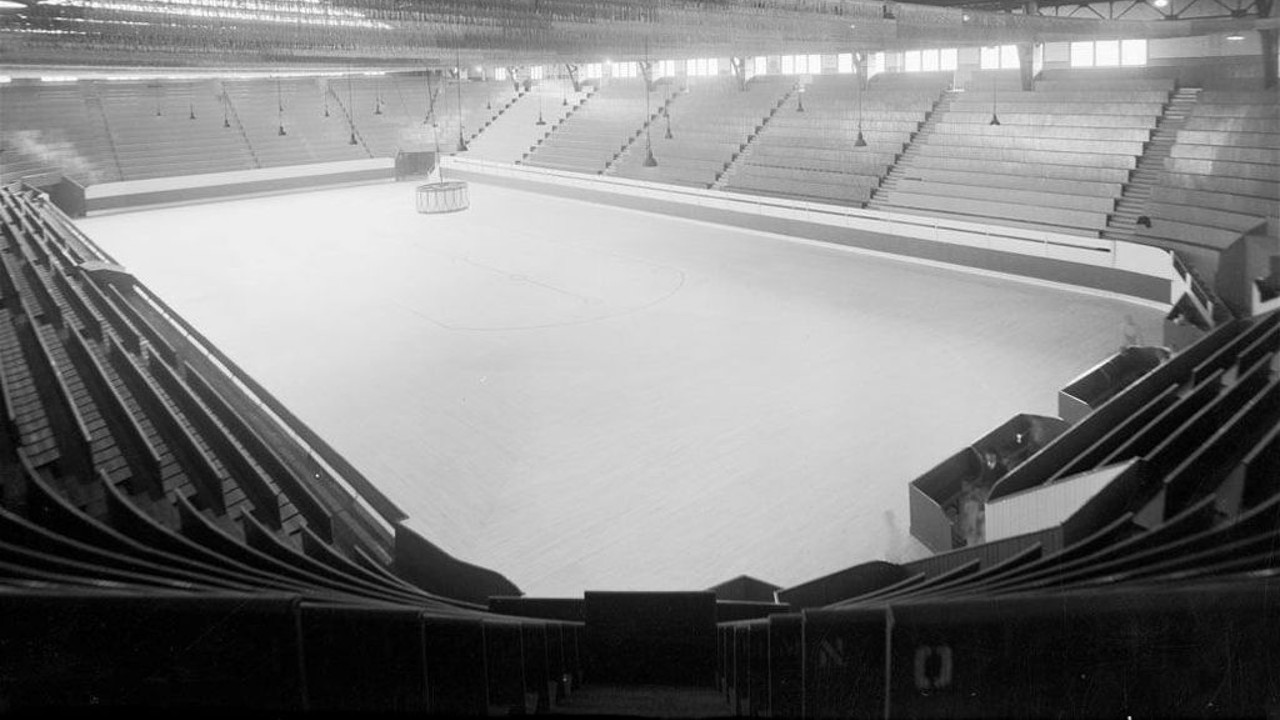
How Toronto's Arena Gardens hosted the first hockey radio broadcast of all time in 1923
It’s an image as Canadian as maple syrup: The whole family gathering around the TV or radio to follow along with Hockey Night in Canada.
Hockey broadcasting holds a unique place in the national imagination, and has for generations. Over the years, it’s evolved to the point where you can consume games from any major market on any day of the week.
But before you could watch on a variety of channels and devices…
And before Hockey Night in Canada was even broadcast on the radio…
Heck, before there were pro hockey broadcasts of any kind…
There was a Toronto Star reporter taking to the airwaves to call the third period of a random game in 1923.
The first hockey broadcast ever
The first hockey radio broadcast took place at Arena Gardens, a now-long-gone arena on Mutual St. near Dundas St. E., on Feb. 8, 1923.
The arena was the original home of the Toronto Hockey Club — the team that would become the Maple Leafs — and the site of Toronto’s first Stanley Cup. (Which doesn’t technically belong to the Maple Leafs. Long story.)
But no Leafs- or NHL-affiliated team was involved in the first hockey broadcast. Instead, it was North Toronto vs. Midland in the Ontario Hockey Association playoffs.
Who called it?
Though Foster Hewitt is often credited with originating the hockey broadcast, the legendary play-by-play announcer was not in fact the first person to call a game via the airwaves.
That honour goes to Norman Albert, a reporter for the Toronto Star.
The Star owned and operated Toronto’s first radio station, CFCA, and had begun broadcasting in April 1922. So it was natural that they would be at the forefront of calling hockey games for the masses.
On the night of the game in question, Albert set up in a small booth near the ice, and described the events of the third period for CFCA listeners.
Here’s how the Star described it in the paper the following day:
“The announcer who described the play was right by the side of the rink and as he spoke, his voice was shot into space…. The vivid description of Norman Albert gave listeners the chance to mentally see the fast action.”
Albert called three more games that same month — including the first NHL radio broadcast on Feb. 14, between the Toronto St. Patricks and Ottawa Senators — before eventually getting replaced by the aforementioned Hewitt, another Star employee at the time.
While no archival audio exists from this era, we do have some home recordings Hewitt made years later. Here’s one from Feb. 12, 1949:
But, wait, what happened in the Feb. 8 game?
North Toronto won 16–4. So Albert’s third-period call came in what would unofficially be known as “garbage time” by today’s standards.
Though the game wasn’t hotly contested by teams we still know and love today, there was still some Canadian sports royalty on the ice that night. Lionel Conacher scored six goals for North Toronto in the Feb. 8 tilt.
Among his many accomplishments, Conacher was named Canada’s top athlete of the first half of the 20th century, and is a member of Canada’s Sports Hall of Fame, the Canadian Football Hall of Fame, the Canadian Lacrosse Hall of Fame, and the Hockey Hall of Fame. (He also played baseball professionally for the Toronto Maple Leafs baseball team.) (He also won boxing and wrestling championships.)
Conacher’s brother Charlie would win the Stanley Cup with the Maple Leafs in 1932. Both Charlie and another Conacher brother, Roy, are also in the Hockey Hall of Fame.
Please share thisVision Zero Toronto’s photo radar program has generated a lot of money, but isn’t slowing traffic like it used to.

Smile, Toronto drivers. You’re on camera.
Toronto’s automated speed enforcement program — otherwise known as photo radar — will celebrate its third birthday this year. Since the city started installing their non-descript grey automated speeding ticket machines near schools in July 2020, the program has nabbed more than a half-million speeding cars, issuing 593,193 tickets, according to data released by the city and last updated through November 2022.
According to the city, the average fine amount is $107.32, so the program has generated estimated potential revenues of about $63.7 million to date.
| Dates active | Jul 2020 - Present |
| Camera count | 50 (growing to 75) |
| Tickets (thru Nov 22) | 593,193 |
| Average fine | $107.31 |
| Revenue | $63.7 million (est.) |
The city initially ordered 50 of the camera machines. They’ve recently started to roll out an additional 25. Because Toronto has more locations with speeding cars than Toronto currently has speed cameras, the machines’ locations are generally rotated every few months.
Top cash cows
Some of these camera locations have proven to be massive cash cows.
A camera at Sheppard Ave. E. and Don Mills Rd., for example, issued 21,288 tickets over five months of service between Dec. 2020 and May 2021, generating approximately $2.3 million in potential tickets alone. It’s the reigning champ for most charges.
Other snap-happy photo radar spots include the camera installed on Parkside Dr., just south of Algonquin Ave. It generated 17,596 charges totalling an estimated $1.9 million since its installation in April 2022.
The Parkside-Algonquin camera’s numbers were so strong the city opted to leave it in place beyond the typical four- or five-month period before rotation. It’s currently in the silver-medal position for most charges issued, but given that it’s still active today, it still has time to take the all-time crown.
Third place goes to the camera on McCowan Rd., just north of Kenhatch Blvd., in Scarborough, which brought in 13,908 charges generating an estimated $1.5 million in fines between Dec. 2020 and May 2021.
These numbers don’t tell the whole story. The machines will lead to traffic tickets — fines only, no demerit points — for owners whose vehicles are snapped doing up to 49 km/h above the posted speed limit. If a car or truck is clocked going faster than that, the vehicle owner will instead receive a summons ordering them to go before a judge and explain why their vehicle was going so darn fast.
The city had clocked 247 mega-speedsters in 2022 as of the end of September. The fastest car among this group was clocked doing 146 km/h in a 50 km/h zone on Martin Grove Rd. in Etobicoke.
"Four cameras were the victim of a heist — vanishing from their podiums even though each camera weighs more than 800 pounds!"
Unpopular, but effective — to a point
Toronto’s photo radar program isn’t likely to win any awards for popularity. As soon as the machines began to appear, angry residents started expressing their frustration. Machines were tagged with spray paint in attempts to block camera lenses. Some were beaten and battered in acts of vandalism. At least one was set on fire. And another four were the victim of a heist — vanishing from their podiums even though each camera weighs more than 800 pounds. (And probably isn’t really valuable on the resale market — would there be any takers on Craigslist?)
The program was never designed to be popular with drivers, though. Instead, the goal was to reduce speeds in a city with too many deaths and serious injuries happening on its streets.
From that perspective, the program is working, though there are signs that the effectiveness may be starting to wane.
The average photo radar camera installation that began in 2020 saw about a 17 per cent reduction in the number of tickets issued on a monthly basis, comparing the first month of operation with data from four months in. The numbers seemed to indicate that drivers would realize the cameras were operational, and slow down. At least in the area around the cameras.
That changed in 2021, with the average decline shrinking to 9 per cent. And in 2022, it fell to just 4 per cent, even as the average number of monthly charges grew to an all-time high.
Comparing data from the first three years of the program, the average number of tickets issued per month has grown from 14,189 in 2020 to 20,914 in 2021 to 23,372 in 2022 (through November).
The estimated average monthly fine revenue has grown accordingly.
| Year | Est. avg. monthly fine revenue |
|---|---|
| 2020* | $1,500,000 |
| 2021 | $2,240,000 |
| 2022** | $2,510,000 |
*Program launched July 2020; **Through Nov.
A win for road safety, but for how long?
These trends may be cause for concern for road safety advocates, even if they have no sympathy for the car owners receiving tickets in the mail. That’s because an earlier attempt at using photo radar on provincial highways in the 1990s was scuttled after public backlash. People saw it as a cash grab more than an effort to enhance safety.
The 20-years-later resurrection of photo radar started on more solid footing, opting to focus on roads in designated “community safety zones” near schools with lots of pedestrian and cyclist traffic, instead of highways. Still, Mayor John Tory was clear when the program launched that he didn’t want it to become a major revenue generator.
“I always said that my objective would be to have these photo radar automated speed enforcement machines issuing no tickets because that would mean people weren’t speeding,” Tory told CP24 in a January 2021 interview.
Almost three years later, the objective of having cameras that issue zero tickets has not been achieved — though there was one machine installed near Vaughan Rd. and Bansley Ave. that issued a grand total of only three speeding tickets between June 2021 and October 2021. In aggregate, the city seems to be moving further away from Tory’s goal.
One explanation may be that City Hall is slow to respond to speeding hotspots identified by the cameras. Along Parkside Dr., for example, the community has long decried the design of the road for encouraging high-speed traffic. The camera installed there backed up the community observation, racking up thousands of charges.
But the process for making physical changes to the road that could result in slower speeds — things like narrowing the roadway, creating some curves, or installing more traffic lights — has been mired in a slow, bureaucratic process, with two rounds of public consultation surveys and a design process. From beginning to end, real infrastructure improvements to the street will take at least three years to go from idea to action.
Multiply that slow process across dozens of streets that could use safety interventions and the time adds up. For City Hall, the challenge remains matching the pace of change to the speed of traffic. Until then, engines keep revving, the cameras keep snapping, and the money keeps rolling in.
Please share thisSunday, February 12, 2023
John Tory's surprise resignation sparks questions about what's next for Toronto

Questions remain about what lies ahead for Toronto following the abrupt resignation of mayor John Tory on Friday night.
The two-term mayor, who had just been re-elected to a third stint in office in October, stepped down over what he described as an inappropriate relationship with a former member of his office staff.
Tory offered few details about the affair during a hastily called Friday night news conference, only saying it had developed during the COVID-19 pandemic and ended by mutual consent earlier this year.
The unnamed employee is now working at another job.
Tory says he’s working with senior city staff and Deputy Mayor Jennifer McKelvie to ensure a smooth transition, but has not formally named his interim successor.
Provincial legislation states a byelection will need to take place within 60 days of the mayor’s office officially becoming vacant to name a permanent replacement.
Ontario Premier Doug Ford thanked Tory, whom he called a friend, for his years of public service including his time in the city’s top job.
“John will be remembered as a dedicated and hard-working mayor who served as a steady leader during the most difficult days of the pandemic,” Ford said in a statement Saturday morning.
“He united Toronto behind an optimistic vision for the future and I will miss working with him to see it come to life. I wish nothing but the best for my friend in the days, weeks and months ahead.”
Tory told reporters late Friday he notified the Office of the Integrity Commissioner of the relationship and asked him to review it, saying he believes it is important to avoid tarnishing the mayoral office or putting City Hall through a prolonged period of controversy over what he describes as an error in judgment on his part.
Tory served two scandal-free terms as mayor of Toronto and had just been re-elected for a third in October.
He thanked the people of Toronto for trusting him as mayor, a position he called “the job of a lifetime.”
“I believe I did some good for the city I truly love, particularly during the pandemic,” he said.
He said the relationship with the employee developed while he was spending long periods of time away from his wife Barbara, to whom he has been married for over 40 years.
“I recognize that permitting this relationship to develop was a serious error in judgment on my part,” Tory said at city hall, where he apologized “unreservedly to the people of Toronto and to all those hurt by my actions including my staff, my colleagues and the public service.”
He said he was stepping down as mayor in order to reflect on his mistakes and focus on rebuilding trust with his family.
He asked for privacy for all affected by his actions, including his wife, family and himself.
Tory, 68, was first elected mayor in 2014, partially on a promise to restore respectability to the office following the scandal-plagued tenure of his predecessor Rob Ford.
He secured a second mandate in 2018 and cruised to a third term in October after a campaign that saw him tout his years of experience as head of Canada’s most populous city.
He secured about 62% of the vote compared to 18% for progressive urbanist Gil Penalosa, who came second. Tory beat out 30 mostly unknown candidates after many criticized his record on transit and housing — two issues he had highlighted as priorities.
In a tweet late Friday night, Penalosa said “now Torontonians have a chance to elect better.”
Tory’s most recent election win came as he faced criticism about the state of Toronto under his leadership. His opponents noted the high cost of housing, aging infrastructure, overflowing garbage bins and shuttered parks.
His leadership saw increased scrutiny in recent weeks over his announcement of a proposed $48.3-million increase to the city’s police budget, which would bring police funding to just over $1.1 billion for 2023 — a figure Tory’s critics said was grossly inflated compared to other line items and underfunded social services.
Tory also saw criticism for his handling of the city’s housing crisis, as thousands of people are experiencing homelessness and Toronto’s shelter capacity is stretched to its limits.
Just this week, Toronto city council scrapped a recommendation to keep its warming centres open around the clock until mid-April after a bout of extreme cold, as well as to declare a public health crisis over lack of shelter space. With support from Tory, council voted instead to call for more federal support and have staff study the idea further.
Kristyn Wong-Tam, a former Toronto city councillor who often disagreed with Tory’s positions and current member of the Ontario legislature, issued a tweet calling Tory’s affair with a staffer “not a simple, one-time lapse of judgment,” but “an abuse of power.”
Toronto city council is set to debate Tory’s proposed budget at a Wednesday meeting. It will be the first under new so-called strong mayor powers granted to Toronto by the province, which Tory had said he would use in a limited and responsible way.
Please share this
Saturday, January 7, 2023
What’s behind Toronto’s ‘staggering’ rise in youth carjackings and pharmacy robberies
Carjackings are up more than 100 per cent in Toronto this year in a string of cases often involving armed youth. Behind the crime wave: organized crime, the opioid epidemic and the promise of “life-changing” money.
$10,000.
That’s how much Toronto police believe a young teen can get for stealing a luxury car at gunpoint and handing it over to adult criminals who then strip the vehicles of any identifiers and, often, ship them overseas.
That astronomical sum — for teens, at least — may help explain why this city is seeing a “staggering” rise in carjackings and other armed robberies involving youth, the head of the force’s hold-up squad said in a rare year-end interview with the Star.
“This year we’ve seen numbers that we haven’t seen in quite a few years,” said Insp. Rich Harris, who’s been busy this year trying to warn the public about how to avoid a carjacking situation and, if so unlucky, how to escape unscathed.
His unit — which handles retail and bank robberies as well as home invasions and carjackings — has seen 164 carjackings this year alone. That’s compared to just 59 in 2021.
Of those arrested, 19 per cent — about one in five — were a young person under the age of 18.
“Those are very concerning numbers,” Harris said.
Experts on youth violence worry ongoing inequalities, highlighted by the pandemic, are contributing to the allure of violent crimes that offer “life-changing” money. Those challenges are not unique to Toronto and are evident in other cities, including across the border.
For young people dealing with these issues, the promise of big money is enticing, said ex-gang leader turned youth advocate Marcell Wilson. And for the older criminals trying to recruit young people into crimes like carjackings, Wilson said, the process is “like putting up a job bulletin.”
Harris agreed: “To put rhyme or reason why specifically we’re seeing so many youths involved, there is some intelligence that would suggest that older persons obviously are facilitating this.”
The trend shows in police bulletins received daily by journalists:
“Four Boys Arrested for Series of Armed Carjackings and Pharmacy Robberies in Toronto & York Region,” read one in October.
The allegations: On multiple occasions a group of four boys stole cars at gunpoint, using a replica firearm, and demanding the drivers’ keys.
Then the group, allegedly using the stolen vehicles to get around, would enter a pharmacy “takeover” style — one pointing a gun at the employees and demanding narcotics and cash before fleeing in the stolen cars.
After being spotted by police getting into one stolen vehicle, they were arrested and charged with multiple offences, including, in the case of the eldest boy, eleven counts of robbery with a firearm.
Their ages: 16, 14, 14 and 14.
There are several different types of crime young people appear to be increasingly involved in.
The first involves luxury vehicles.
:format(webp)/https://www.thestar.com/content/dam/thestar/news/gta/2022/12/17/whats-behind-torontos-staggering-rise-in-youth-carjackings-and-pharmacy-robberies/_2_harris.jpg)
When the car is the target
In these cases, police believe adults are alerting younger acquaintances to in-demand models and recruiting the young people to steal them at gunpoint — sometimes arming the youth — and then directing them to a holding location, where the car can “cool off,” meaning have its GPS tracking and other identifying components removed. That’s where the young person’s role ends, relied upon just for the initial robbery that, if arrested, could mean less punitive sentences because their age would see them charged under the Youth Criminal Justice Act (YCJA).
When the adults take over, the cars are often moved to a shipping yard in containers where they can be sent overseas, police say, with certain marques in high demand — including Porsche, Mercedes, Volkswagen and Audi.
That demand has come in part because supply has been very low during the pandemic. According to Consumer Reports, auto manufacturers built 1.7 million fewer vehicles in 2021 than in 2019 due to backlogged supply chains for various components.
That supply and demand issue is also apparent in the steady increase in non-violent auto thefts in Toronto, up more than 80 per cent since 2017 to 6,572 cases in 2021.
When it comes to the high-end vehicles, some with push start buttons, Harris said, offenders “will go out of their way to solely target those vehicles” and use “the element of surprise” to take control of that car.
In February, the hold-up squad, working with several other forces and agencies, announced the arrest of seven suspects aged 20 to 23 in a series of “high-end” carjackings in which 19 vehicles were recovered, including Lamborghinis, Bentleys and Porsches.
“Investigators allege that the accused parties would use various distraction methods and then swarm victims as they exited or entered their vehicles,” the press release said. “Once stolen, it is further alleged that the GPS capabilities on the cars were removed before attempts were made — sometimes successfully — to transport the vehicles overseas.”
Security camera footage released by police in one instance shows a light-coloured Lamborghini SUV pulling into a driveway near Yonge St. and Finch Ave. as another car, police allege with three men inside, can be seen pulling up to the foot of the drive. The Lamborghini disappears from view into what appears to be a garage as two people, allegedly brandishing a knife, can be seen getting out of the second car and running up the driveway. Police said they demanded the victim’s keys and cellphone. The second car blocks the driveway as an altercation takes place between what appears to be one of the suspects and a victim. Then, one person returns to the vehicle at the end of the driveway as the Lamborghini backs out.
From there, police said York Regional Police Service helped track the car using GPS and a helicopter, leading the men to abandon the luxury SUV, which can retail at a base cost of around $250,000.
Footage from a police chopper shows an ongoing pursuit before police eventually caught up with the suspects. A total of four men were arrested and charged with robbery, trafficking of property obtained by crime and other offences.
The draw for stealing these higher-end cars is evident in the payoff.
“It’s a very lucrative business for the younger persons,” said Harris.
“The higher-end vehicles, there’s some intelligence that suggests those at, we’ll call it, Stage 1 where the carjacking takes place and the high-end vehicle is obtained, they’re getting in excess of $10,000 per vehicle.”
He called that a “life-changing” amount of money for these young people.
But, he said it’s clear the youngest people involved in the crimes aren’t the masterminds of the operation.
“The evidence would suggest that there’s no way the younger persons are 100 per cent behind the whole planning and execution,” he said, noting that police continue to work with Canada Border Services Agency and others to target overseas trafficking.
When the car is a tool in ‘hybrid’ crimes
The second type of carjacking young people are engaging in is quite different.
Less expensive cars are being targeted to be used as getaway vehicles in other crimes, including shootings, Harris said. But one of the most common uses for a getaway car in 2022 has been in armed robberies of pharmacies, a crime in which 45 per cent of those arrested this year have been youth.
Pharmacy robberies have increased 131 per cent this year, to 113 from 49 in 2021.
Harris calls those “hybrid” crimes — both aspects, the carjacking and the pharmacy robbery, involve his unit.
When it comes to pharmacy robberies, the money in the register is only a bonus, Harris said.
“They are targeting, without doubt, the safes where the narcotics are kept.”
Investigators’ working understanding, based on the amount of narcotics being taken, is that stolen opioids are headed for illegal street sales in a city living through an ongoing overdose epidemic.
“With the demand, you gotta get the supply,” Harris said. “The amounts that are taken would suggest that there’s no way someone’s just using that for recreational use.”
In all cases, Harris noted these crimes are not victimless and often the trauma of having a weapon — replica or not — pointed or shown at a driver or store clerk is long-lasting.
“It’s one of those trends that we want to see curbed immediately, because the lasting effects that it has on the victims of these crimes, you can’t measure.”
He said the force’s engagement unit is working with pharmacists to be on alert for signs of possible robbery and how to protect themselves, including making sure their shop has clear sightlines to the street by removing signs and other window coverings.
Meanwhile, the Ontario College of Pharmacists voted on Dec. 12 to begin the process of requiring all community pharmacies to use time-delayed safes and signage promoting their use to passersby. The move will mean staff won’t be able to open safes for would-be robbers without a delay of several minutes, a delay that should discourage many robberies. Final approval is still required at a meeting in March 2023.
In a statement, the college said they are “monitoring the concerning rise in pharmacy robberies across Ontario” and said, “the safety and security of pharmacy teams and patients is a significant priority.”
“This type of crime puts people’s physical and mental health at risk, and stolen medications can contribute to the province’s illicit drug supply.”
As carjackings have ramped up, police have created a task force to deal with the crimes and continue to broadcast public advice: comply immediately, give up your car, get somewhere safe and call police.
Police have also warned drivers to be aware of their surroundings and not to sit in their cars with the doors unlocked or idle in isolated areas. Further, car owners can invest in anti-theft devices and try to park in well-lit, high-traffic areas.
:format(webp)/https://www.thestar.com/content/dam/thestar/news/gta/2022/12/17/whats-behind-torontos-staggering-rise-in-youth-carjackings-and-pharmacy-robberies/_3_school_shooting.jpg)

What’s happening with Toronto youth
Each case of armed youth crime tells its own story, Harris said.
“To get to the root cause as to what would cause a young person to get involved in this, each one is different,” he said.
In 2022, four teens under the age of 18 have been killed to date in shootings, including one fatally shot in a school parking lot, a rate on par with the previous four years. An 18-year-old boy was also killed in the hallway of his Scarborough high school.
Beyond fatal incidents, advocates remain worried about the level of violence among teenagers, playing out both inside and outside of schools.
In North York, incidents at York Memorial C.I. and criticism of the administration’s handling of them — some of which stem from other issues like systemic racism — have led to staff refusing to show up to work and students staging protests over an unsafe learning environment.
Meanwhile, the city continues to face a shortage of resources for at-risk youth, while youth workers experience burnout and a lack of confidence the government has the right funding priorities.
Research suggests inequities highlighted by the pandemic could be a factor in the rise in youth crime.
Last year, the University of Chicago posted data on the spike in carjackings in that city during the pandemic.
By tracking where arrested youth lived, the researchers found a trend that overlapped with areas with low internet access and class attendance as well as disproportionately high substance abuse, gun violence and other factors — what the director of the school’s Crime Lab, Jens Ludwig, wrote in the Chicago Tribune was a “pressure cooker of trauma, violence and isolation.”
In Canada, similar conditions exist, and Statistics Canada has noted “widespread concerns about young people’s labour market prospects” since the start of the pandemic.
Before the lockdowns, Canada was experiencing a near-record low in youth unemployment but starting March 2020, the rate increased to 28.8 per cent, higher than during the Great Recession.
Akwasi Owusu-Bempah, associate professor of sociology at the University of Toronto who focuses on race and justice issues, noted that youth unemployment for Black youth is also typically two times higher than the national average.
Combined with poor living conditions, a lack of opportunities and these youth not seeing themselves as having a “full stake in society,” Owusu-Bempah said these factors contribute to being recruited into organized crime.
At the same time, economic disparities continue to grow. The income divide in Toronto has widened, with the affluent, he noted, driving around in luxury vehicles.
“I don’t want to characterize these kids are Robin Hoods,” he cautioned. But “for some it’s probably basic needs,” he said, noting he’s watched the line for the food bank near his home grow over the last couple of years.
And, he said, adults “have often exploited the fact that young people are treated less harshly in the criminal justice system.”
Wilson, the former gang leader who now runs the One By One Movement to help intervene with at-risk youth, agreed organized criminals are not going to risk sacrificing their “good soldiers” to jail time for armed robberies and instead rely on youth who face more lenient YCJA penalties.
But the potential payoff for young people has grown, too.
Wilson explained that in his day new Jeep Cherokees were in particular demand, but the reward was just $1,000 per vehicle. And they weren’t carjacking — instead, they were stealing vacant cars and attracting far less attention.
Harris said there is evidence the teens who are committing armed crimes have access to “community guns” shared among multiple people or that guns are for rent in some neighbourhoods for use in carjackings and other crimes.
Though his unit has not drawn a connection between teens committing armed robberies and ongoing school shootings, Harris said the fact alone young people are armed is concerning.
Harris said the fact alone that young people are being armed raises the spectre of more violent incidents.
“Is it a possibility with kids with firearms? That is a possibility.”
Please share this